
From Idea to Reality in a Clack


As the world accelerates toward carbon neutrality, rooftops are transforming from passive architectural elements into active sources of clean energy. Discover how Riverclack®, the Italian-engineered standing seam system, is redefining the concept of roofing systems with photovoltaic systems for large buildings combining energy efficiency, design flexibility, and absolute waterproof performance.
In the transition to a sustainable future, every surface counts. Roofs, once viewed as static protective layers, are being reimagined as integral components of the energy ecosystem collecting sunlight, generating electricity, and contributing to climate neutrality.
For large buildings such as airports, industrial complexes, and logistics centres, this evolution is particularly significant. These structures, often covering tens of thousands of square meters, possess enormous untapped potential for clean energy production. A well-designed solar roof for large buildings can generate enough electricity to offset a substantial portion of a facility’s operational demand cutting both emissions and costs.
However, implementing photovoltaic systems at this scale brings a set of complex engineering challenges: maintaining waterproofing, managing structural loads, ensuring safety, and optimizing long-term maintenance.
This is where Riverclack®, a pioneering roofing technology made in Italy, offers a clear advantage.
Europe’s new Energy Performance of Buildings Directive (EPBD) and its “EU Solar Standard” marks a decisive shift in how buildings are designed and renovated.
By 2026, all new public and commercial buildings will need to be solar-ready. By 2028, existing non-residential buildings with roof areas exceeding 500 m² undergoing major renovations will be required to install solar panels, where technically and economically feasible. While national transpositions may vary, the direction is unmistakable: for roofs exceeding 500 m², photovoltaic integration will soon be the norm, not the exception.
This change represents both a responsibility and an opportunity for building owners. The responsibility to comply with environmental regulations—and the opportunity to capitalize on on-site renewable generation, reduce energy bills, and enhance building value.
In this context, roofing systems with photovoltaic systems for large buildings are no longer a niche option; they are fast becoming an industry standard.
Italian engineering has long been synonymous with elegance and precision. Riverclack® embodies this tradition in the field of architectural roofing.
Riverclack® was conceived to solve one of architecture’s oldest dilemmas: how to guarantee total watertightness while maintaining creative freedom and structural performance.
Over the years, it has become a global benchmark for high-performance metal roofing, installed on airports, sports facilities, museums, and industrial buildings worldwide.
Today, Riverclack® is extending its design philosophy to renewable energy integration—offering a solution that transforms metal roofs into industrial photovoltaic roofing made in Italy, combining efficiency, safety, and aesthetic harmony.
No perforation, no compromise: the Riverclack® principle
The biggest challenge in solar roofing is how to mount photovoltaic panels without compromising the roof’s waterproofing. Traditional systems require drilling or mechanical fastening, which inevitably introduce potential leakage points and weaken the insulation layer beneath.
Its patented snap-in standing seam profile allows solar modules to be attached without a single perforation. Specialized clamps grip the seam’s profile mechanically, securing the panels firmly in place—no screws, no holes, and no sealing required.
This simple innovation translates into multiple technical and economic advantages:
This unique non-penetrative design is what makes Riverclack® particularly suited for solar roofs for airports, where reliability, safety, and maintenance efficiency are paramount.
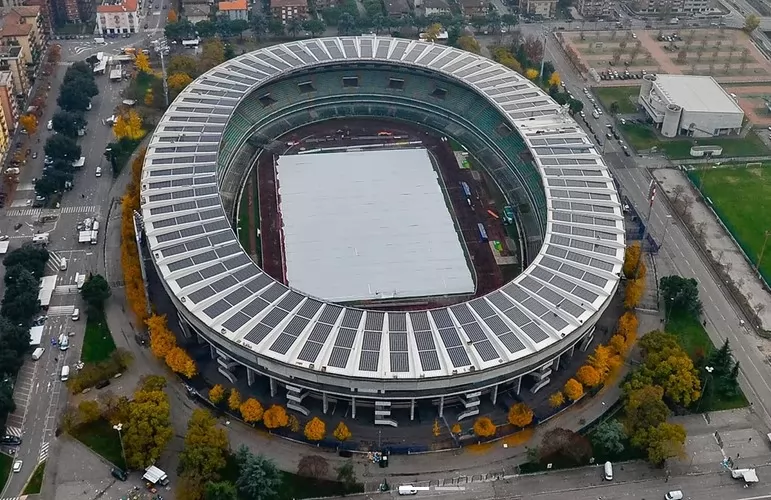
Large-scale roofs are rarely uniform or simple. They feature complex geometries, varying slopes, and demanding load conditions. Riverclack®’s design flexibility allows architects and engineers to adapt the system seamlessly to almost any shape flat, curved, or tapered without compromising mechanical performance.
The system’s aluminum standing seam profiles are engineered to accommodate thermal expansion and differential movement, ensuring stability even across vast spans. This adaptability makes Riverclack® an ideal choice for solar roofs for industrial buildings, where large uninterrupted roof areas must maintain structural reliability and precise alignment over time.
When choosing a roofing system for photovoltaic integration, proven reliability is essential. Riverclack® has been tested under the most demanding international standards for watertightness, wind uplift, and load-bearing capacity.
The system’s ability to remain watertight even when submerged is a testament to its engineering precision. This unique feature unmatched in the market guarantees confidence for both architects and building owners.
To date, more than 40 MWp of photovoltaic installations have been integrated on Riverclack® roofs worldwide, across industrial facilities, airports, and large commercial structures. These projects demonstrate not only the system’s technical robustness but also its economic efficiency over decades of operation.
Airports represent some of the most complex roof environments in the world massive surfaces, stringent safety regulations, and constant exposure to the elements. Riverclack® has been used in major international airports precisely because it provides leak-free continuity and minimal maintenance, two critical features for aviation infrastructure.
Integrating solar modules into these roofs enables airports to partially offset their enormous energy demands from terminal lighting to HVAC systems while maintaining the architectural coherence of large-span structures.
In industrial contexts, where every hour of downtime carries financial consequences, reliability and speed of installation are critical.
Riverclack®’s snap-fit photovoltaic solution allows companies to rapidly transform their roofs into clean-energy generators without disrupting operations or compromising thermal insulation.
The lightweight aluminum structure ensures minimal additional load, even when thousands of panels are installed across large surfaces.
For public buildings and retail centers, the aesthetic and sustainability value of a solar-integrated roof is a significant asset. Riverclack®’s clean lines, seamless joints, and curved configurations make it suitable not only for efficiency but also for architectural expression turning functional surfaces into design features that reflect environmental commitment.
Beyond technology: ESG, circularity and long-term value
As sustainability metrics become central to investment and corporate strategy, the roof plays a surprising but strategic role.
Choosing a solar roof for large buildings with a high recycled content, long service life, and energy-generation capability directly supports ESG (Environmental, Social, and Governance) targets.
Riverclack® aluminium panels are fully recyclable, lightweight, and corrosion-resistant reducing both the environmental footprint and the structural demand on the building.
By generating renewable energy on site, the system helps large organizations reduce Scope 2 emissions, qualify for green certifications such as LEED or BREEAM, and align with the EU Taxonomy criteria for sustainable construction.
In addition, Riverclack® roofs are low-maintenance systems. Over decades, this translates to lower lifecycle costs, a reduced need for replacements, and consistent operational performance key metrics in any long-term ESG evaluation.
As building envelopes evolve, the boundaries between architecture and energy production are disappearing. Tomorrow’s roofs will not only protect but also generate, regulate, and contribute to the energy ecosystem of entire cities.
Riverclack® stands at the forefront of this transformation. Its perforation-free photovoltaic roofing system merges architectural vision with engineering precision an Italian innovation designed for the global energy transition.
From industrial complexes to international airports, from manufacturing plants to civic landmarks, Riverclack® proves that sustainability and durability can coexist above every building silently transforming sunlight into power, and roofs into the future’s most valuable real estate.
Versatile, Easy-to-Install, Long-Lasting, Sustainable
 About Us
  Why Riverclack®
  Systems
  Technical Support
  Projects
  Designed for
  Contacts
  Join Us