
From Idea to Reality in a Clack


Searching for a metal roofing system made in Italy isn’t just about origin labelling. It’s about specifying a package of design intelligence, high-quality materials, rigorous test evidence and architectural refinement that suits demanding public projects: airports, stadiums, hospitals and universities. Modern Italian metal roofing manufacturers combine advanced coil metallurgy, premium surface systems, tested mechanical locking details and installation methods that are specifically tailored for large-scale, complex roofs. Among them, Riverclack® specialises in secret-fix, walkable standing-seam systems that are explicitly engineered to be PV-ready and to perform on large roofs.
Italian metal roofing stands out for four complementary strengths:
Choosing the right substrate and coating is fundamental to lifecycle performance.
Why: Lightweight, corrosion-resistant, formable for curved geometries and fully recyclable. Ideal for retrofits where dead loads matter. EPDs for anodised and pre-painted aluminium are commonly available for procurement documentation.
Why: Where structural stiffness and cost-efficiency are priorities, modern coated steels (e.g., Magnelis® — a Zn-Al-Mg alloy coating) dramatically improve corrosion resistance, including on cut edges and deformed zones, compared to traditional galvanised options. That makes them suitable for exposed façades and many roof types where steel’s mechanical properties are required.
Why: PVDF 70/30 is the industry benchmark for architectural coil coatings: excellent UV and weather resistance, low dirt pickup and long warranties, important for public buildings that must retain appearance with minimal maintenance. Specify manufacturer data sheets and warranty terms.
Public tenders and architects should demand documented compliance with the most relevant standards and tests:
Excellent materials and certificates don’t guarantee outcomes unless installation is carefully controlled.
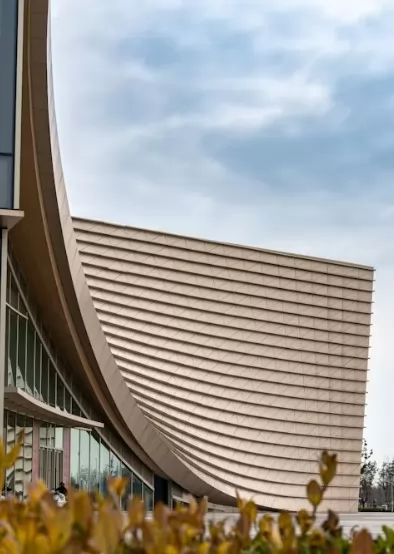
Public projects demand durable, low-maintenance, high-performance roofs that can be maintained over decades while meeting strict procurement and safety rules.
Airports and Transport Hubs: need watertightness, wind resistance and integrated PV potential, standing seam, secret-fix systems answer these. Riverclack® lists a portfolio of airports and transport installations that illustrate this application.
Stadiums and Large Assembly Buildings: require curvature, noise control and large drainage capacities. Modular aluminium systems scale to huge spans and maintain acoustic and drainage performance.
Hospitals and Schools: require non-combustibility, hygiene, durability and predictable lifecycle costs, aluminium and documented EPDs support lifecycle budgeting and fire classification needs.
Riverclack® blends Italian design with global delivery capability: engineered secret-fix standing seams, walkable and PV-ready panels, project experience on airports, stadiums and institutional roofs, and published technical literature and test data to support public procurement. For procurers and architects who need a single-source supplier capable of supplying material, technical documentation and system guidance for large public buildings, Riverclack® provides a compelling, documented option.
When performance, reliability and architectural quality are non-negotiable, the choice of roofing system becomes a strategic one. Riverclack® represents the highest expression of a metal roofing system made in Italy: engineered aluminium standing-seam solutions, proven on some of the world’s most demanding public buildings, fully compliant with international standards and inherently designed for long-term durability and PV integration.
Choosing Riverclack® means relying on a system, not just a product, backed by decades of technical expertise, certified performance, and a track record that includes airports, stadiums, universities and institutional landmarks. It means protecting your investment with a perforation-free, watertight, walkable and future-ready roof that enhances architectural design while reducing lifecycle risk and maintenance costs.
Versatile, Easy-to-Install, Long-Lasting, Sustainable
 About Us
  Why Riverclack®
  Systems
  Technical Support
  Projects
  Designed for
  Contacts
  Join Us