
From Idea to Reality in a Clack
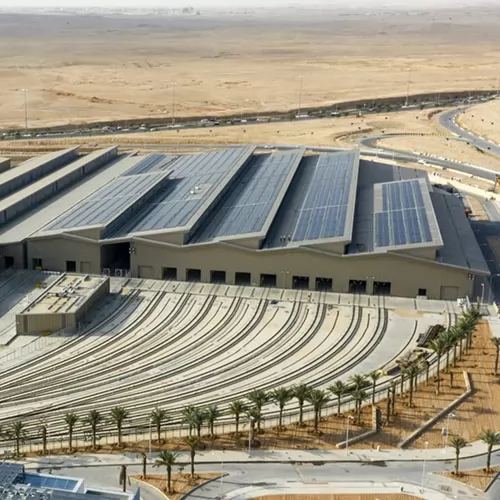


The construction sector is responsible for roughly 37% of global CO₂ emissions, according to the latest Global Status Report for Buildings and Construction by UNEP and the Global Alliance for Buildings and Construction. For architects, contractors, and developers working on industrial and commercial projects, that figure is no longer just a statistic: it is a variable that shapes specifications, tenders, and investment decisions.
Regulatory pressure keeps rising, ESG criteria increasingly decide which suppliers make the shortlist, and clients demand eco-friendly roofing materials that are also documentable. In this environment, choosing a roofing system carries a strategic weight that goes far beyond its protective function.
Yet one material makes it possible to combine long-term technical performance with environmental responsibility, without compromise: aluminum. Aluminum metal roofs are today the most concrete answer for anyone building industrial and commercial facilities meant to last for decades while maintaining a measurable sustainability profile. This article explains why, starting from the real challenge architects and builders face.
Over the past few years, the idea of sustainability in industrial construction has changed radically. It is no longer a value-added feature to showcase in a company brochure, but a concrete requirement that influences every stage of the building process, from design to end-of-life.
Developers in the logistics, manufacturing, and commercial segments now face a threefold pressure:
In this context, the roof is one of the building elements with the greatest impact on the overall assessment of a project. In a warehouse or a logistics center, we are talking about surfaces that can span thousands of square meters: the choice of material is therefore not a technical detail, but a strategic decision with consequences for cost, timelines, maintenance, and the positioning of the entire project.
The real challenge for architects and builders is to find eco-friendly roofing materials without sacrificing durability, ease of installation, and low operating costs — a challenge that means moving past the traditional trade-off between sustainability and performance.
The term eco-friendly is used very loosely, but a serious assessment cannot stop at the raw material. The environmental impact of a roof is measured across its entire life cycle and depends on four factors that must be considered together.
The first is the origin and production of the material: how much energy and how many resources it takes to make. The second is durability: a roof that stays effective for decades avoids the cycles of removal, disposal, and replacement, each of which carries a far-from-negligible environmental cost. The third is end-of-life recyclability, that is, what happens to the material when the building is decommissioned or the roof replaced. The fourth, often underestimated, is the impact on the building's energy performance throughout its service life.
A genuinely low-impact roof must perform well on all four fronts, not excel at just one. This is where the specific choice of material comes in: metal roofs start with an advantage, but not all metals offer the same guarantees. It is in a direct comparison that aluminum shows why it stands apart.
Comparing materials on a single parameter easily leads to the wrong conclusions. A bituminous membrane, for example, has a low upfront cost but a short service life and a problematic end of life. Traditional tiles are durable but heavy and hard to reuse. Steel offers good mechanical performance but is more prone to corrosion and heavier for the same surface area.
Assessed across its full life cycle, aluminum presents a profile that is hard to match. Compared with other roofing materials, it stands out on several fronts:
Aluminum's strength does not lie in topping a single category, but in the balance: no other material combines long life, light weight, corrosion resistance, and total recyclability. This balance is exactly what Life Cycle Assessment (LCA) studies reward, which is increasingly required for environmental building certifications, because they measure a material's real impact across its whole cycle, not just at the production or installation stage. Over the long term, aluminum is one of the most eco-friendly roofing materials available today.
If there is one property that makes aluminum the benchmark among eco-friendly roofing materials, it is its total, unlimited recyclability. Aluminum can be melted down and reused an indefinite number of times without losing its mechanical qualities: the material protecting an industrial warehouse today could tomorrow become a new roof, a profile, or a component, with no drop in performance.
On top of this comes a fact that weighs heavily on the environmental balance sheet: recycling aluminum requires only a small fraction of the energy needed to produce it from raw material. This means that every ton of aluminum fed back into the cycle avoids energy consumption — and therefore emissions — far greater than that of recycling itself. It is no coincidence that a very significant share of all the aluminum ever produced is still in use today, precisely because it is recovered rather than discarded.
This has direct consequences for environmental certifications. In LCA studies, end-of-life recyclability and recycled content affect a building's overall score: an aluminum roof therefore contributes concretely to improving a project's green credentials, not just on paper. For a contractor or developer, all of this translates into a measurable advantage: the roof is not a "sunk" environmental cost, but an asset that retains value even at the building's end of life. Recyclable aluminum in construction is one of the few materials that genuinely embodies the principle of the circular economy.
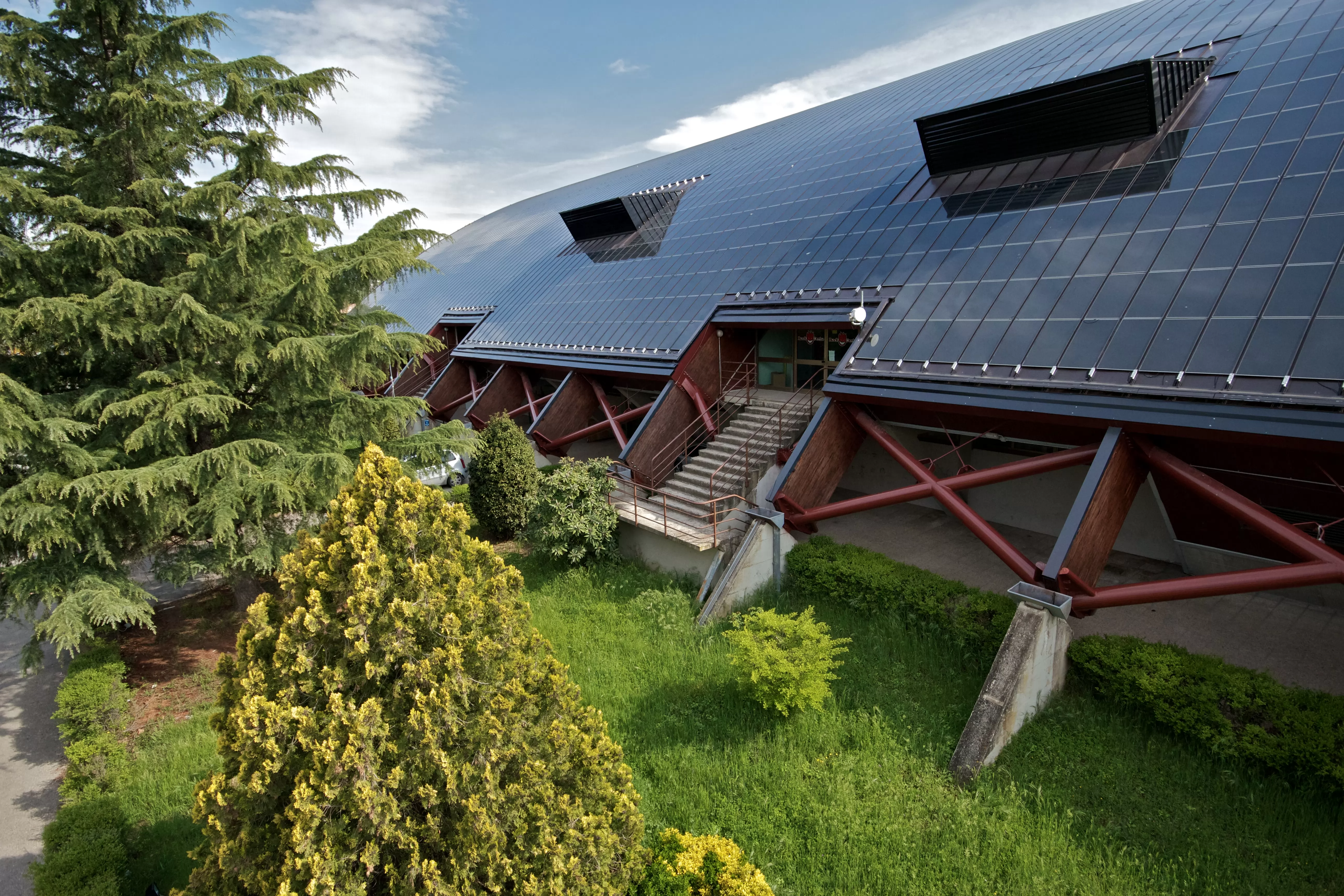
The sustainability of an aluminum roof does not end with the properties of the material. A good roofing solution acts on the entire building, reducing its impact both during construction and in operation.
Aluminum is significantly lighter than most traditional roofing materials. For the same covered surface, this means lower permanent loads on the load-bearing structure. The benefit is twofold: on one hand, it allows for leaner structures, using less material and therefore lowering the overall footprint of the build; on the other, it makes aluminum particularly suited to interventions on existing buildings, where the margins for added load are often limited.
Over surfaces of thousands of square meters, such as those of warehouses and logistics centers, even a modest difference in weight per square meter produces meaningful structural savings. A lightweight roof is, in many cases, a roof that lets you build — or renovate — using fewer resources.
A green industrial roof is not just made of eco-friendly materials: it actively contributes to the building's energy efficiency. Aluminum finishes can be engineered to reflect part of the solar radiation, reducing summer overheating. Added to this is aluminum's natural readiness to integrate with photovoltaic systems, which find in a lightweight, durable metal roof an ideal support for large-scale installations without problematic overloads.
In large industrial and logistics buildings, where operating consumption accounts for the largest share of the overall environmental footprint, reducing cooling demand and hosting large photovoltaic arrays bears directly on the building's decarbonization targets; the most advanced systems also allow panels to be anchored without perforating the sheet, preserving the roof's watertightness. The roof thus becomes not a passive element, but an integral part of the building's energy and environmental strategy.
A roof's primary job is to protect the envelope: water infiltration compromises insulation and structure, triggering repairs or replacement work that carries an environmental as well as an economic cost. The way roofing elements are joined therefore also affects overall sustainability. Drainage-joint systems manage water without relying on sealants or gaskets and without perforating the sheet, reducing the weak points prone to degradation and extending the interval between one intervention and the next. From a life-cycle standpoint, the most sustainable roof is the one you never have to redo.
Translating aluminum's advantages into a genuinely reliable roof, however, requires a system engineered to bring them out at their best. The Riverclack® system was created with exactly this goal: to unite the inherent sustainability of aluminum with watertightness and durability at the top of its category.
Made from 5754-H18 aluminum alloy — the same used in marine and naval applications for its outstanding corrosion resistance — the Riverclack® system delivers stable performance over time even in severe environments, keeping maintenance to a minimum. It is a lightweight covering, made to measure and fully recyclable at end of life, suited both to new builds and to work on existing structures. The drainage joint at the heart of the system also ensures reliable watertightness even in the most demanding conditions, with no sealants or perforations of the sheet.
Riverclack® thus brings all of aluminum's environmental benefits to the site, proving that durability and low environmental impact can coexist: a roof that lasts for decades, is endlessly recyclable, lightens structures, and improves the building's energy performance is, in every respect, a smart choice for contractors and developers with a long-term outlook.
If you are evaluating the roof for a new project or the retrofit of an existing building, talking it through with a specialist is the best way to understand how to translate these advantages into your specific application. The Riverclack team is available to guide you toward the solution that best fits your needs.
Versatile, Easy-to-Install, Long-Lasting, Sustainable
 About Us
  Why Riverclack®
  Systems
  Technical Support
  Projects
  Designed for
  Contacts
  Join Us