
From Idea to Reality in a Clack
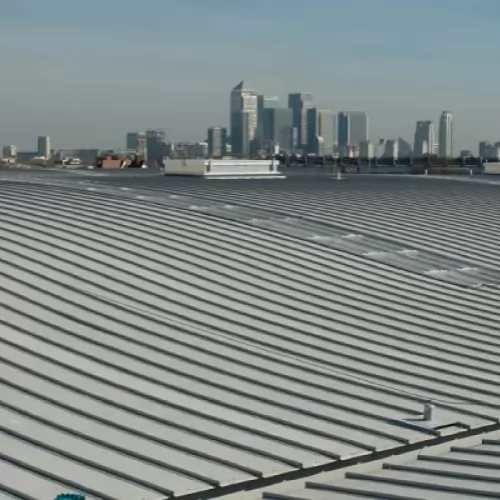

When evaluating the roof of a logistics warehouse, a manufacturing plant, or a large commercial building, the figure that grabs attention first is the price per square foot quoted at bid stage. It's an understandable reference, but a partial one: that number describes only the initial investment and ignores everything that happens over the next three, four, or five decades.
The real metal roof cost, in other words, is not exhausted by the purchase price. For a decision-maker — architect, general contractor, or facility manager — the right question is not "what does this roof cost today," but "what will it truly cost over the entire service life of the building."
It is from this perspective that a high-performance aluminum roof like the Riverclack® system reveals its real economic value.
Comparing two bids by looking only at cost per square foot is seeing just the tip of the iceberg. The true metal roof cost is best captured by the total cost of ownership (TCO): the sum of every outlay the roof generates over its life — purchase, installation, maintenance, repairs, any business downtime, and end-of-life replacement.
A roof that is cheaper to buy can prove the most expensive over time if it requires frequent maintenance, has a short service life, or exposes the building to the risk of water infiltration. Thinking in terms of cost annualized over the actual lifespan — rather than entry price — is what separates an informed building decision from an apparent saving. The gap is anything but theoretical: in industrial construction, a roof bought at the lowest price and one engineered to last may start from very different initial costs yet completely reverse their relative value within a few decades.
To assess an investment properly, you have to break it down. The components that make up the real cost of an industrial roof are essentially six:
It is above all the last three items that determine which solution is truly economical over the long run.
Over a thirty- or fifty-year horizon, not all types of metal roofing behave the same way: the durability of the material becomes the dominant factor. Standing seam metal roofs are recognized in the industry as among the longest-lasting for commercial and industrial construction, with service lives commonly in the range of 40-50 years and beyond, against low-initial-cost solutions — such as some synthetic membranes — whose lifespan is typically shorter. The Metal Roofing Alliance places the service life of metal roofs well above that of asphalt-based membranes, which require far more frequent replacement.
This is where the features of the Riverclack® system have a direct impact. Made from high-performance aluminum, the roof does not corrode and stays unaltered over time: at just 0.7 mm thick it delivers performance equal to or better than roofs using much thicker sheet, and it has a stated century-long service life — in practice, it is engineered to last as long as the building itself. Over the long term, this means that where a cheap alternative might require one or more full re-roofings, a roof of this kind spans the entire life cycle of the property without replacement.
The economic return of a high-performance roof does not come from any single element, but from the systematic elimination of recurring cost items. It helps to look separately at the three fronts on which this saving is generated.
The first and most direct saving is in maintenance. The Riverclack® system fastens the panels with a snap-together connection, with no screws piercing the sheet and no gaskets or sealants. The difference from a traditional roof is substantial: in systems with penetrating fasteners, every screw that goes through the sheet is a potential point of infiltration, and every sealed joint is a material subject to degradation that must be inspected and periodically restored. It is precisely these elements that generate most routine interventions over a roof's life.
By eliminating them at the root, the system drastically reduces the scheduled maintenance plan. Added to this is the integrated drainage channel, which ensures watertightness even when the roof is completely flooded: the roof keeps protecting the building even when the primary barrier is under stress, reducing the frequency of extraordinary work tied to severe weather events. Over a 30-50 year horizon, the absence of repeated resealing cycles translates into a recurring cost item that simply never arises.
The second saving, often overlooked at the evaluation stage, concerns accessibility. The roof is fully walkable: it withstands a concentrated load of up to 400 kg and keeps its integrity even after repeated foot traffic, with no permanent deformation. In an industrial building this carries a concrete economic weight, because the roof is never an inert surface: it hosts HVAC equipment, air-handling units, cable trays, lifelines, and — increasingly — photovoltaic systems, all of which require periodic inspection and work.
Being able to walk freely on the roof without risking damage means that maintaining rooftop equipment involves neither added protection costs (walkways, temporary decking) nor the risk of creating, during access itself, the damage and micro-punctures that later turn into leaks. It is a saving that adds up over the entire life of the building and grows with the amount of equipment installed on the roof.
The third saving is the hardest to quantify but often the most significant: protecting operational continuity. In a logistics warehouse, a manufacturing plant, or an automated warehouse, the value of what sits beneath the roof — machinery, production lines, goods, IT systems — far exceeds the cost of the roof itself.
A leak that reaches a production line or a storage area does not generate only the cost of repairing the roof: it entails direct damage to assets, possible downtime, and, in some cases, unfulfilled orders. Reliable, stable watertightness over time eliminates this category of risk at the source. This is where roof reliability stops being a technical matter and becomes a lever for protecting the company's bottom line.
Beyond cutting costs, a well-designed roof can create value, further improving ROI.
Every Riverclack® roof is PV ready: with the dedicated Riverclack® Energy line, photovoltaic systems install with a simple snap-together connection, without piercing the panels. The large surface of the warehouse thus becomes an asset that produces energy — and therefore income or savings on the utility bill — without ever compromising the roof's watertightness. Metal roofs also contribute to the building's energy efficiency: according to the U.S. Department of Energy (DOE), "cool roof" metal surfaces can reduce cooling costs by up to 25%.
On the industrial front, on-site roll forming also matters: panels can be produced on location at any length, with spans exceeding 100 meters (over 300 feet) and no joints. On very large roof planes this eliminates overlap points — potential sources of infiltration and maintenance — and speeds installation. Finally, aluminum's full 100% recyclability affects end-of-life cost and answers the ESG criteria increasingly present in specifications and procurement procedures.
To compare bids correctly, it helps to shift the evaluation from the purchase price to the cost over the entire life cycle. Some criteria to include as early as the specification stage:
Applying these criteria, a higher initial investment stops being a cost and becomes what it truly is: the choice that minimizes total spending over 30-50 years.
Every industrial building has different surfaces, design constraints, and risk profiles: it is against these that the real cost of a roof is measured. Since 1987, Riverclack® has supported architects, construction firms, and facility managers with a dedicated technical service, able to guide the choice of the most efficient solution at every stage of the project.
If you are evaluating the roof of a new building or the re-roofing of an existing one, contact the Riverclack® technical team for a life-cycle cost analysis calibrated to your project and to receive the system's technical documentation. Together, let's turn the price per square foot into the figure that really matters: total spending over the decades ahead.
Versatile, Easy-to-Install, Long-Lasting, Sustainable
 About Us
  Why Riverclack®
  Systems
  Technical Support
  Projects
  Designed for
  Contacts
  Join Us